
How a Black Hole and a Shredded Star Could Light Up a Galaxy
How a Black Hole and a Shredded Star Could Light Up a Galaxy
By Carolyn Collins Petersen (https://ift.tt/MYrKujI)
April 18, 2026 at 02:33AM
via read more...
By Carolyn Collins Petersen (https://ift.tt/MYrKujI)
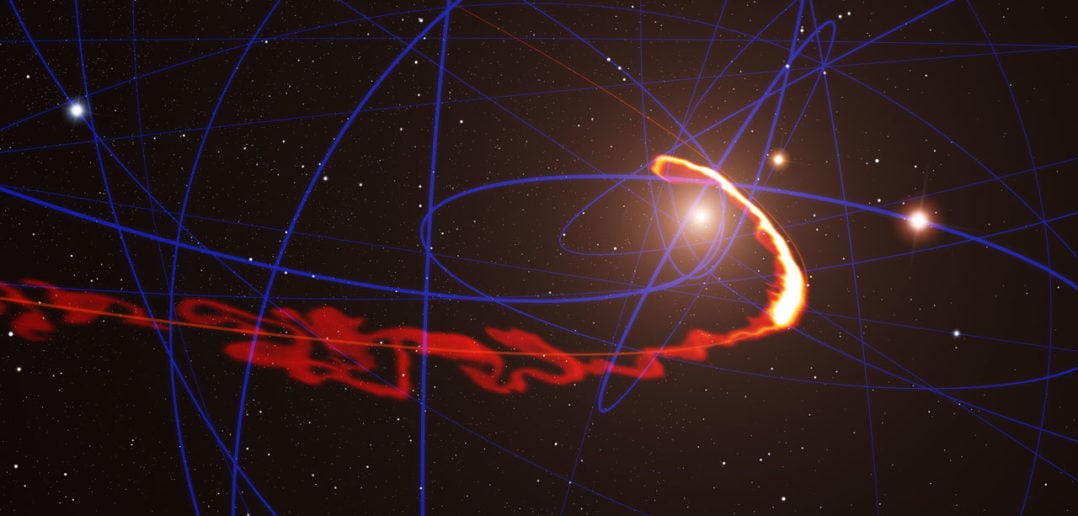
In 2014, a strange cloudy object called G2 made a close approach to Sagittarius A*, (Sag A*) the supermassive black hole at the heart of the Milky Way Galaxy. Astronomers were pretty excited, partly because they thought it might get torn apart by Sag A*'s intense gravitational pull. That didn't happen, and the event was a cosmic fizzle. Instead, G2 skipped around the black hole. Various observations showed that it wasn't just a gas cloud. It was likely a dusty protostellar object encased in a dusty cloud. Or perhaps several merged stars. But, it survived the flyby and continued on a shortened orbit.
April 18, 2026 at 02:33AM
via read more...


Post a Comment